
A Short Guide to Inerrancy at SoCal Christian Colleges and Seminaries
Did Jonah really get swallowed by a big fish? Did New Testament writers use pseudonyms (fake names)?


Is the creation account mythological or historical?
Is Moses the original author of Deuteronomy?
What is meant that “the sun stood still” during the battle in Joshua 10:13?
Don’t be surprised if your college gives a different answer than your church.
Back in 1978, when I was a wee lad, more than 200 men gathered in Chicago to discuss modern conceptions of biblical inerrancy. Through much discussion and study together, they formulated what is known as the Chicago Statement on Biblical Inerrancy.
— Wayne Grudem, Systematic Theology, 90.

These pastors and academics gathered together from various denominational backgrounds and sought to correct various wrong understandings of the Bible and its authority. The list of those attending and signing the document is amazing, both for the theological diversity evident and the range of ages present. Having seen institutions fall to liberal theology, these men sought to definitively state the doctrine of inerrancy in a way that could not be redefined to mean something else.

At our church, I often get asked about various seminaries and Christian colleges nearby, Are they good?, Is that a solid place for my son/daughter to attend? In light of these ongoing questions, I thought it would be helpful to take a look at how nearby seminaries and colleges agree or disagree with the Chicago Statement.
Here is the Chicago Statement’s shortest articulation of biblical inerrancy:
Being wholly and verbally God-given, Scripture is without error or fault in all its teaching, no less in what it states about God’s acts in creation, about the events of world history, and about its own literary origins under God, than in its witness to God’s saving grace in individual lives.
So let’s compare that with the most well-known Christian colleges & seminaries in our area (Southern California):
- Westminster Theological Seminary
- Talbot School of Theology / Biola University
- Fuller Theological Seminary
- The Master’s Seminary / The Master’s University
- Point Loma Nazarene University
- Cal Baptist University
- Azusa Pacific University
- Westmont College
- Grand Canyon University
Westminster Seminary California
We believe that the Scripture is the very Word of God written. Since God can neither lie, be mistaken, nor change, his Word cannot contain error. Therefore, Scripture is inerrant. … (We believe) that Scripture’s primary subject is the message of redemption from sin through Jesus Christ. But all Scripture’s subject matter is God’s Word and always true. When Scripture speaks to matters of history, science, ethics, or anything else, it is true and authoritative, and it governs our thinking in these areas.


WSC began as a branch campus of the Philadelphia-based Westminster Theological Seminary. In 1982, it became fully independent but shares a similar theological heritage. WSC uses the Westminster Confession and Catechisms, along with the Belgic Confession, Heidelberg Catechism and the Canons of Dort, as their doctrinal standards.
Because of contemporary doctrinal controversies, the WSC faculty adopted A Testimony to our Time, which clearly outlines the seminary’s positions on issues like inerrancy, hermeneutics, creation, and the ordination of women. The WSC articulation of inerrancy stands in solid accord with the Chicago Statement on Biblical Inerrancy.
Biola University / Talbot School of Theology
The Scriptures of the Old and New Testaments are without error or misstatement in their moral and spiritual teaching and record of historical facts. They are without error or defect of any kind.

The italicized quote above is taken from their doctrinal statement. Notice that their articulation of inerrancy restricts its meaning to moral and spiritual matters primarily
A nuanced reading leaves open the option that the biblical record of history was not intended to be understood as ‘fact’ and therefore should not be understood as literal. In contrast to the Chicago Statement, the Bible is not explicitly stated to be error-free regarding where modern scientific discoveries may contradict it.
I hear differing accounts of where Talbot and Biola staff are on the doctrine of inerrancy. All I can conclude is that their doctrinal statement would allow faculty to have some flexibility in how they define inerrancy.
Fuller Theological Seminary
Scripture is an essential part and trustworthy record of divine self-disclosure. All the books of the Old and New Testaments, given by divine inspiration, are the written Word of God, the only infallible rule of faith and practice. They are to be interpreted according to their context and purpose and in reverent obedience to the Lord who speaks through them in living power.

Fuller does not find the Chicago Statement to be helpful or accurate, as they devote most of their webpage on ‘What We Teach’ describing how they differ from a classic view of biblical inerrancy.
The Master’s Seminary / The Master’s University
We teach that the Word of God is an objective, propositional revelation (1 Thessalonians 2:13; 1 Corinthians 2:13), verbally inspired in every word (2 Timothy 3:16), absolutely inerrant in the original documents, infallible, and God breathed. We teach the literal, grammatical historical interpretation of Scripture which affirms the belief that the opening chapters of Genesis present creation in six literal days (Genesis 1:31; Exodus 31:17).



Though they share the same president and name, its interesting that they each have their own doctrinal statement. Nevertheless, The Master’s University and The Master’s Seminary each stand in firm alignment with the Chicago Statement on Biblical Inerrancy.
The prelude to the Seminary’s doctrinal statement expresses its intentionality to guard against doctrinal drift over time, such that its board of directors, administration, and faculty are all required to sign a statement of affirmation each year, expressing their agreement with the Seminary’s doctrinal positions.
Point Loma Nazarene University
We believe in the plenary inspiration of the Holy Scriptures, by which we understand the 66 books of the Old and New Testaments, given by divine inspiration, inerrantly revealing the will of God concerning us in all things necessary to our salvation, so that whatever is not contained therein is not to be enjoined as an article of faith.
Point Loma puts absolutely nothing on their website about what they believe, other than their affiliation to the Church of the Nazarene. So the above statement is from their denominational page. When you search the university’s events and publications, you will find that they are strongly committed to Wesleyan/Arminian doctrine and believe that biblical inerrancy is an undesired outcome of Calvinistic theology.
The Wesleyan principle of “the sufficiency of Scripture” differs from Reformed theology’s more rigid notion of “the inerrancy of Scripture.” — Point Loma Monograph #4
C. S. Cowles, former PLNU faculty, articulated that difference in 2009 in an open letter he penned while serving as Professor of Theology there.
It was in the vain hope of escaping these divisive disputes over the Bible that the Church of the Nazarene avoided, from its very beginning, using such hot-button words as ‘inerrancy’ and ‘infallibility.’ It was only under pressure from a vocal minority at the height of the early 20th century Fundamentalist-Modernist controversies that the General Assembly compromised, and inserted the word “inerrancy” into the Manual in 1956. In doing so, however, the delegates—following the counsel of Dr. H. Orton Wiley, one of our church’s most eminent theologians and my graduate school professor—limited it to “all things necessary for salvation.” This had been the intent of Article IV anyway since the Church’s founding in 1908.
As the rest of Cowles’ letter makes clear, PLNU (and the Church of the Nazarene) would be at clear odds with the Chicago Statement on Biblical Inerrancy.
Cal Baptist University
The Holy Bible was written by men divinely inspired and is God’s revelation of Himself to man. It is a perfect treasure of divine instruction. It has God for its author, salvation for its end, and truth, without any mixture of error, for its matter. Therefore, all Scripture is totally true and trustworthy. It reveals the principles by which God judges us, and therefore is, and will remain to the end of the world, the true center of Christian union, and the supreme standard by which all human conduct, creeds, and religious opinions should be tried. All Scripture is a testimony to Christ, who is Himself the focus of divine revelation.

CBU derives its doctrine from the Southern Baptist Convention’s doctrinal statement, The Baptist Faith & Message. For those unfamiliar with SBC history, the above statement of Scripture is in its revised 2000 form, and distinct from the 1963 version. Due to the Conservative Resurgence within the SBC and their wresting control of the denomination from theological moderates in the 1980's, the SBC and its educational institutions like CBU now fully affirm biblical inerrancy, as articulated in the Chicago Statement.
Azusa Pacific University
We believe the Bible to be the inspired, the only infallible, authoritative word of God.

At face value, APU’s statement sounds good. The problem is what they mean when they say that the Bible is infallible. As Ligonier Ministries points out,
Some theologians in recent years have redefined the concept of infallibility in order to promote a lower view of the bible, so it is important to ask people what they mean when they say the Scriptures are infallible.
In APU’s case, they are communicating a lower view of the Bible than what the Chicago Statement affirms.
Westmont College
The Bible, consisting of the Old and New Testaments, is God-breathed and true, without error in all that it teaches; it is the supreme authority and only infallible guide for Christian faith and conduct-teaching, rebuking, and training us in righteousness.

Westmont proclaims a commitment to Christ, with a campus pastor and regular chapel services. It’s trustees, administrators and faculty “participate in many different churches and with them confess such historic statements of the church as the Apostles’ Creed and the Nicene Creed.”
Their view of the Bible’s inerrancy is accordingly varied, determined by the tradition of the person hired. Their doctrinal guide suggests that Scripture be viewed as infallible, rather than inerrant. The Bible is reliable regarding matters of Christian conduct and beliefs. By what’s written, man is placed as a judge over Scripture, forced to determine what is intentionally taught by Scripture and what is extraneous and in need of correction. The chair of their religious studies department exemplifies this method.
Grand Canyon University
We believe the Bible, in the Old and New Testament Scriptures to be inspired, the only infallible, true and authoritative Word of God.
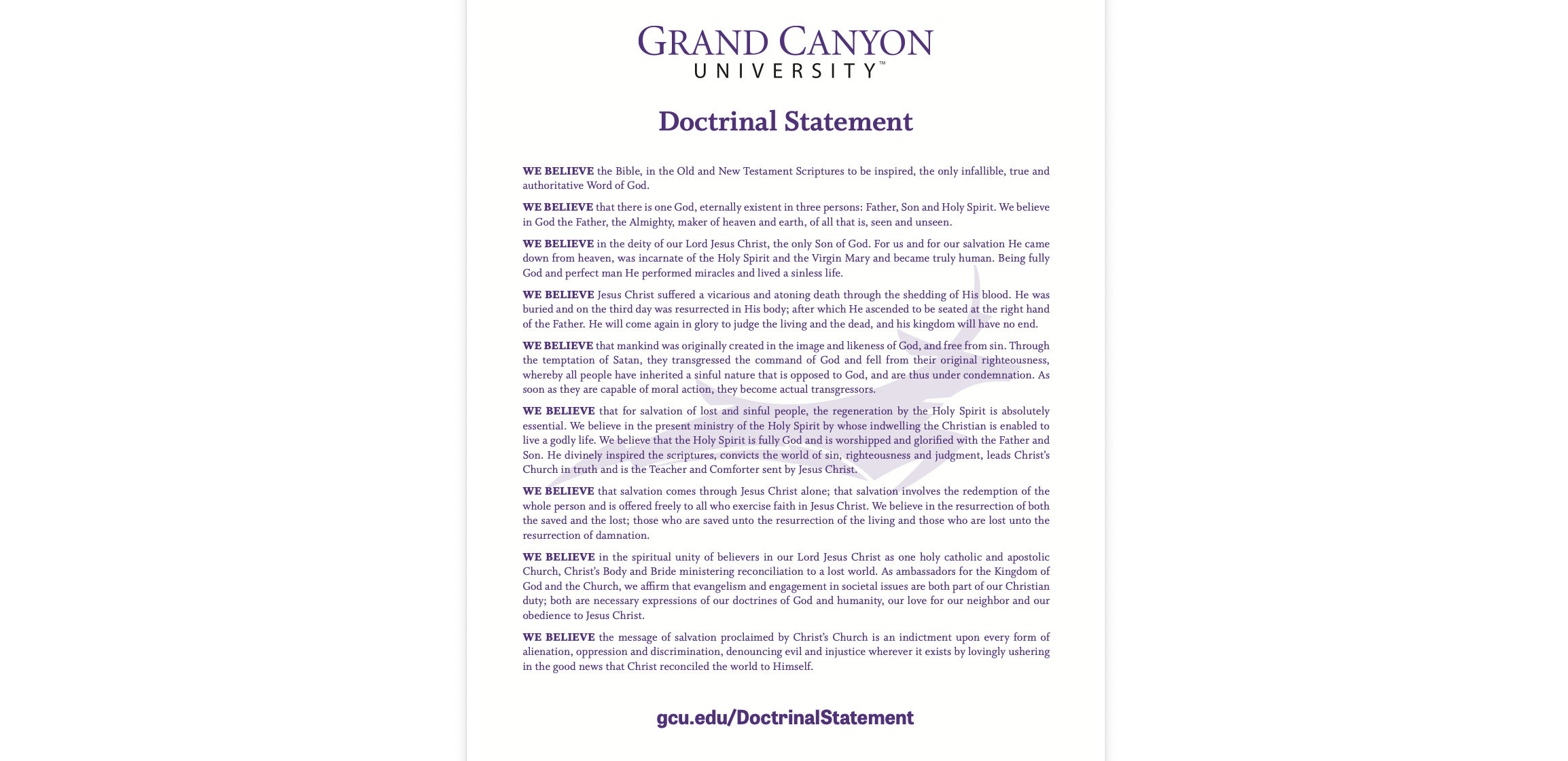
The doctrinal statement for Grand Canyon University is fairly brief, as pictured above. They also provide a longer form,Ethical Positions paper, that describes their view on various contemporary issues like creation, abortion, sexuality, academic freedom, etc.
The brevity of their statement on Scripture limits one’s ability to be enthused or disappointed by their convictions. Sadly, their Ethical Positions paper states that “the Bible serves as the final standard and authority in all matters of faith and practice.”
This, alongside their earlier use of ‘infallible’ in place of ‘inerrant’ would lead me to conclude that the administration may hire faculty who would be at odds with the Chicago Statement on Biblical Inerrancy.
Concluding Thoughts
Judging a seminary or college based on its view of the Bible will necessarily present an incomplete picture. Do not take the above comments as a wholesale commendation or condemnation of any college, university or seminary. Each has strengths and weaknesses beyond how it views Scripture.
Every school is the sum of its faculty. Yet professors are rarely monolithic in their theology.
Without a firm commitment to inerrancy, expect that the faculty of a college or seminary will be more likely to advocate extra-biblical authorship of certain books, evolutionary theory over the creation account, natural law over biblical miracles, etc. This is not a matter of hermeneutics, but one of biblical authority.
Is the Bible correct about all things, or only regarding matters of faith and practice?
Know that the doctrinal statement of an institution will be the last thing to change. It notifies the world of what the majority of its faculty have already come to accept as true. Their stated doctrine should shape your expectations about what will be heard/taught there, but you should always expect outliers—some who press the bounds of the institution’s doctrine, and others who are more conservative theologically than their peers.
If you want a true sense of a university or seminary’s current doctrinal beliefs, then survey the writings of its faculty (journals, blogs, books, interviews) and their courses (youtube, university website). That research today is easily accomplished at a computer or tablet.